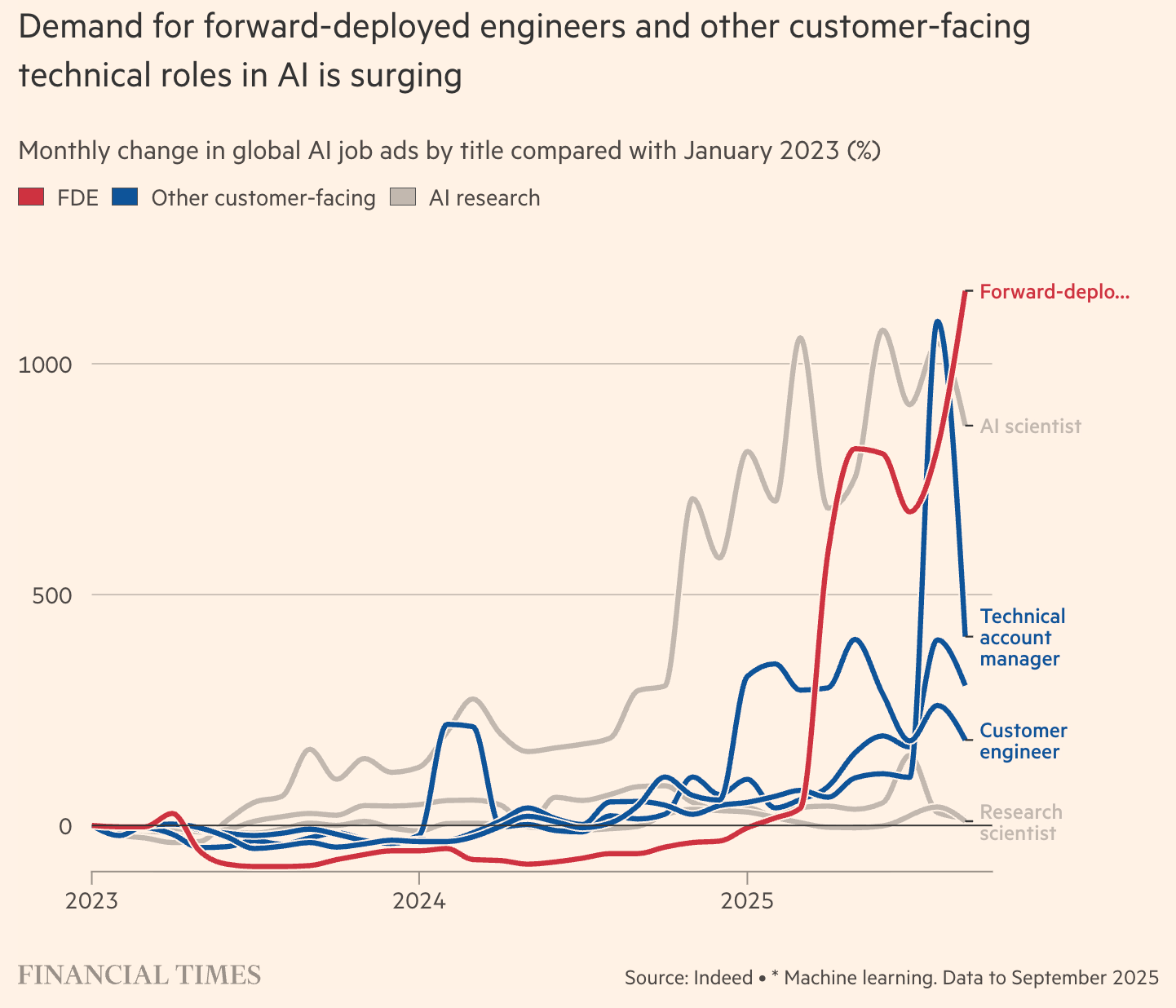
Two years ago, almost nobody in Silicon Valley, and nobody in Latin America, was talking about Forward Deployed Engineers. Today, FDEs come up in nearly every conversation about AI agents. The FDE role is one of the hottest jobs in tech; monthly job listings for FDEs increased by over 800% between January 2025 and September 2025.
An FDE is an engineer who both writes code and works directly with customers. They sit inside the customer’s office, solving complex problems in real time. Palantir created the role about twenty years ago by sending engineers into the field to sit with users, learn their systems, and ship real software. The goal of an FDE isn’t to integrate existing tools but rather to build new ones that solve specific business problems. As Palantir’s Head of AI in the UK, Nic Prettejohn, puts it, an FDE does “product discovery from the inside.”
FDEs are not consultants who advise and leave. They’re not product engineers working on a roadmap far from users. They sit next to the customer, find what’s broken, and fix it.
For a deep dive on what an FDE does, read Gergely Orosz’s article.
The wave of AI agents is driving demand for FDEs
The rise of AI agents is making good FDEs even more valuable. MIT found that 95% of internal AI projects are failing, mostly because data integration across big companies is a mess. In many big companies, for example, it can take weeks for the Sales team to get the data they request from Finance.
Without clean, connected data, AI systems break. As Phil Schmid says, “Most agent failures are not model failures anymore, they are context failures.”
Good FDEs fix the context problem because they know where data lives, how to clean it, and how to make models actually work in the real world.
As former Chief Research Officer at OpenAI Bob Mcgrewsaid, “A lot of AI agent startups’ moat is really building personalized agents that can access all your data.”
FDEs are becoming ubiquitous in Silicon Valley startups, but we’ve seen almost no companies hiring FDEs in Latin America. We believe the time is now for the first wave of FDEs in Latin America.
FDEs are even more important in Latin America because enterprise sales is much harder
As we’ve written about, SaaS is hard to scale in Latin America because sales cycles are slower, data lives in disconnected systems, and companies want proof before they buy.
We’ve seen enterprise deals drag for 12+ months, with founders saying they’re “really close to closing” the whole time. Usually, Latin American enterprise deals die on the vine for one of two reasons:
Your sales to onboarding takes too long
Implementing your product isn’t a top 5 priority for the client
The gap between sales and execution is where FDEs can be most helpful. A good FDE:
Deeply understands the problem the customer is trying to solve
Proves value fast by working directly with customers and getting daily feedback loops
Digs through messy systems until they build a product that actually works.
Good FDEs don’t just help pilots work or build small scale proof of concept software. They are in charge of the entire implementation and onboarding process for customers, and are responsible for solving a specific problem.
But FDEs aren’t for everyone. Few companies in Latin America are both built to benefit from FDEs and are culturally ready to give them the autonomy they need.
The company readiness FDE checklist: When it makes sense to hire FDEs
You should consider hiring FDEs if:
You sell big contracts to large enterprises
You have long sales and onboarding cycles
Deals stall between pilot and payment
You are solving a complex problem for a client that requires deep integration or data work to succeed
But being ready to hire FDEs isn’t just about your product. Many Latin American startups are not culturally ready to hire them. You’re ready to hire FDEs only if:
You’ll give FDEs autonomy to build new software, not just implement existing software
Your internal product team can turn what FDEs build into a repeatable product
Over the last few months, we’ve talked with several portfolio companies about whether they need FDEs. The answer depends on stage and complexity:
A SaaS company charging $200 a month with a one day onboarding doesn’t need FDEs .
A SaaS selling $15k monthly enterprise contracts but struggling to get from pilot to payment should consider hiring FDEs.
And at the earliest stage, when there’s barely revenue and no product-market fit yet, the technical founder is the FDE. They should be the one talking to users, building, and iterating daily.
The FDE candidate checklist: What makes a great FDE
Your first FDE hires will set the tone for how your customers experience your company. Hire real engineers who can ship end-to-end and thrive in chaos. The best FDEs:
Have built something themselves before
Build trust fast and communicate clearly, without jargon
Are able to find and structure all types of data
Prioritize shipping products fast versus perfecting software
How to launch your first FDE team in Latin America
Figuring out how many FDEs you should hire can be tricky. About 50% of Palantir’s team are FDEs. 30% of Happy Robot’s team are FDEs.
Our recommendation is to start small with 1 or 2 FDEs and hire more only when you know it works. Start by deploying one FDE to work with one customer.
It’s fine if an FDEs job is service-heavy to start. Palantir and Salesforce both began roughly as 80% services and 20% product businesses before flipping that ratio as they scaled.
Your goal is to gain leverage with each deployment. Getting your hands dirty is good. But every integration should be faster than the last one. Your first FDE might take 6 months to build a product that solves your first customer’s problem. But 6 months later they should be able to be overlooking multiple accounts. Track these metrics to see if you’re moving in the right direction:
% revenue coming from services vs. product: Are you becoming a real product company?
Revenue per FDE: Are your engineers getting more efficient?
Time to first value: Are you getting faster at deploying?
Contract size growth: Are you upselling?
Being an FDE is a great training ground to become a founder
One of your main jobs as a founder is to build a product that customers actually want and will pay for. That job is the exact responsibility of an FDE.
Spending a few years as an FDE is one of the best paths to becoming a founder. FDEs learn what real problems look like inside big companies and how to turn chaos into working software. At Palantir, every Product Manager starts as an FDE, and 30% of PMs who leave Palantir go on to start their own companies.
We’re looking for the first generation of FDEs in Latin America
We think the first generation of FDEs in Latin America will be tomorrow’s top technical founders. We’re building a community of ambitious FDEs all across Latin America to work at some of the 125+ companies that we have invested in.
If you think you could be a fit and want to be a part of the first wave of FDEs in Latin America, apply here, and we’ll be in touch.